The Guadalupian-Lopingian boundary mass extinction event ("GLB event"), also known as the end-Guadalupian mass extinction, is considered a global extinction event that not only affected some marine fauna but also led to the disruption and destruction of terrestrial ecosystems.
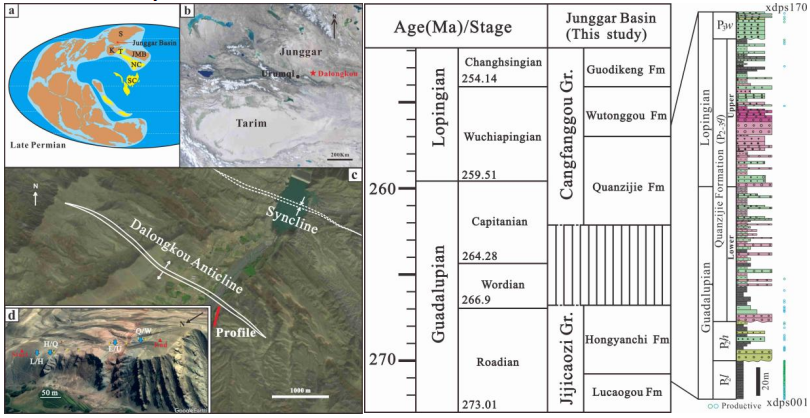
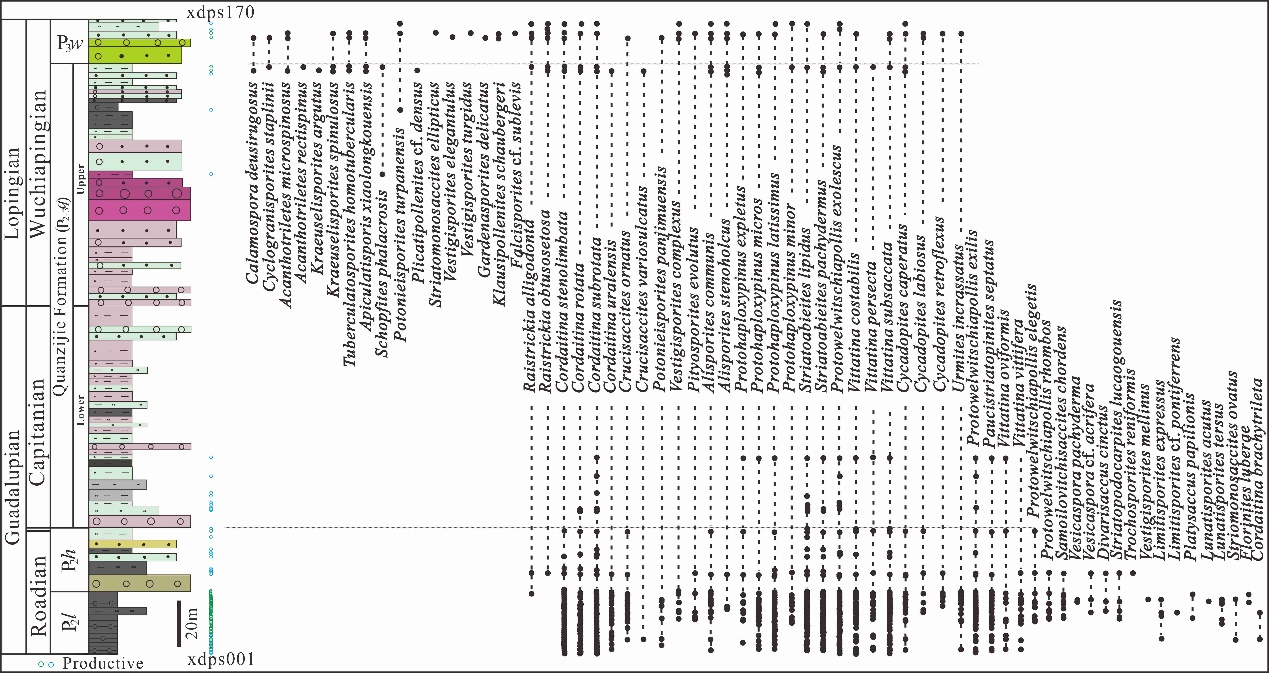
Since 2017, research team of Professor Yuewu Sun from International Centre for the Geoscience Research and Education in Northeast Asia and the Research Center of Palaeontology and Stratigraphy, Jilin University has been conducting palynostratigraphy and the GLB event in the Guadalupian–Lopingian (Permian) strata in the Junggar Basin, supported by the National Natural Science Foundation of China. Through detailed analysis and identification of pollen and spores in 170 palynological samples collected from the upper Lucaogou Formation, Hongyanchi Formation, Quanzijie Formation, and lower Wutonggou Formation in the Dalongkou profile of Jimsar, Xinjiang. Two palynological assemblages have been established in ascending order: the Cordaitina subrotata–Striatoabieites lipidus–Protowelwitschiapollis exolescus (CSP) assemblage from the upper Lucaogou Formation to the lower Quanzijie Formation, and the Kraeuselisporites spinulosus–Tuberculatosporites homotubercularis–Potonieisporites turpanensis (KTP) assemblage from the upper Quanzijie Formation to the lower Wutonggou Formation.
Based on the palynological data, the upper Lucaogou and Hongyanchi formations are assigned to the Roadian stage, and the lower Quanzijie Formation to the late Capitanian stage, and the upper Quanzijie and lower Wutonggou formations to the early Wuchiapingian stage. Thus, a Wordian-age hiatus is confirmed between the lower Quanzijie Formation and the Hongyanchi Formation on the basis of palynological evidence.
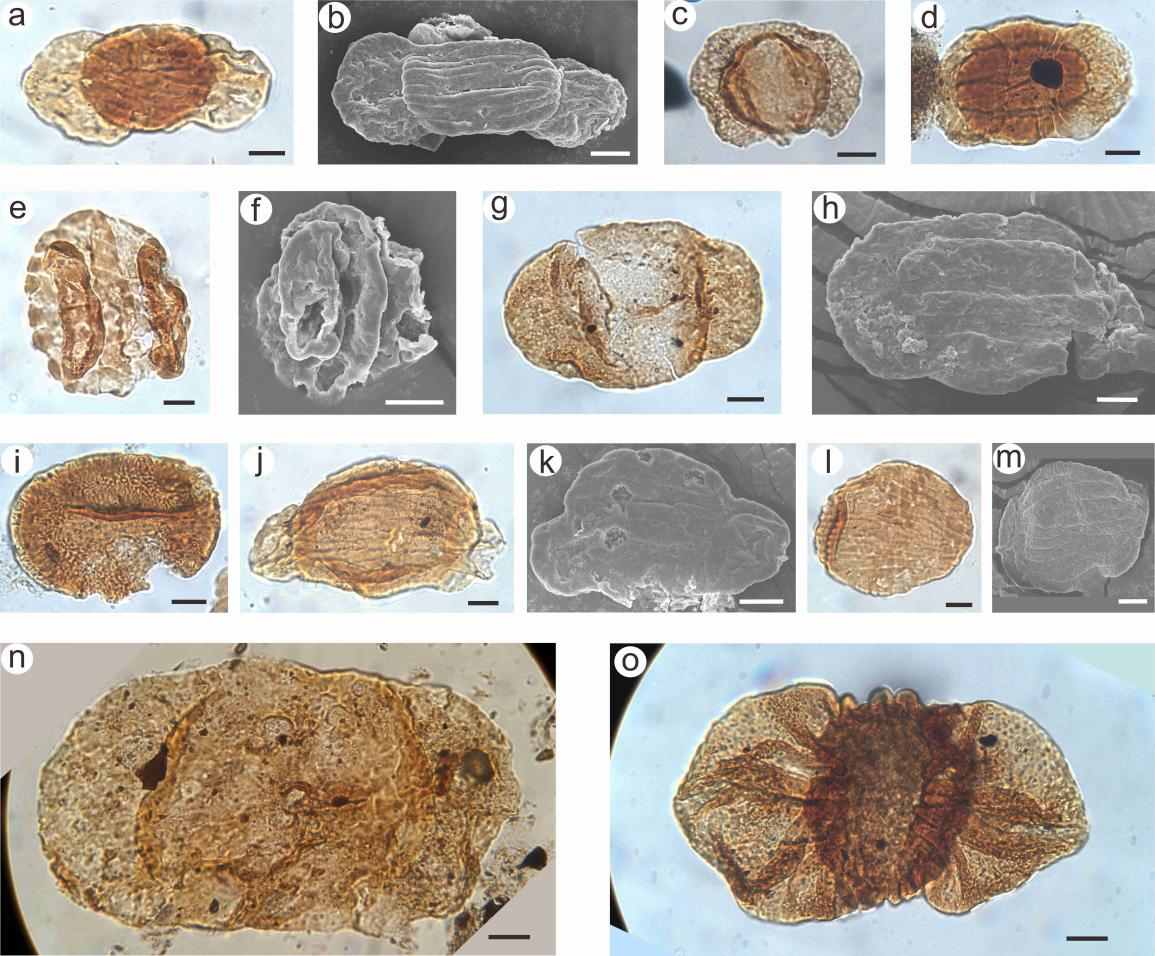
Meanwhile, according to the vertical distribution of pollen and spores, it was found that among the CSP assemblage at the upper Lucaogou Formation and the Hongyanchi Formation, twenty-one pollen species were not detected in the Lopingian upper Quanzijie and lower Wutonggou formations in this study. However, ten of the twenty-one species occur in the Lopingian Wutonggou and Guodikeng formations in the Junggar Basin, and other two species occur in the Lopingian Linxi Formation in Inner Mongolia. Thus, only nine species have been recorded in neither the KTP assemblage nor Lopingian palynofloras globally. Consequently, among the 53 species within the CSP assemblage, 9 species have become extinct. The extinction rate stands at 17%, notably lower than that of mass extinctions, which surpass 75%; and this would be regarded as a background extinction.
The above research, titled "Terrestrial end-Guadalupian crisis constrained by mid-latitude Permian palynological data from Jimsar, Junggar Basin, China" was published in the geological journal Review of Palaeobotany and Palynology. DOI: 10.1016/j.revpalbo.2025.105445.
