Recently, a joint research team from the Institute of Vertebrate Paleontology and Paleoanthropology, Chinese Academy of Sciences, the American Museum of Natural History, and our center published results on triconodonts in Acta Palaeontologica Polonica on April 25, 2026. Using high-resolution micro-CT scanning and other techniques, the study redescribed in detail the tooth morphology of the Early Cretaceous Gobiconodon zofiae and reported a new species from the Quantou Formation in Gongzhuling City, Jilin Province—Gobiconodon gongzhulingensis sp. nov., and redefined the key characteristics of Gobiconodon, revealing its unique tooth evolution and occlusal pattern.
Eutriconodonta is a Mesozoic mammalian group characterized by a triconodont molar structure, i.e., three main cusps arranged in a mesiodistal direction. Gobiconodon is a diverse genus within Eutriconodonta, exhibiting a basically triconodont tooth pattern, with some species showing incipient triangulation of the main cusps. However, there has been a long-standing controversy in the academic community regarding the number of teeth and species delineation in Gobiconodon, which has made it difficult to determine accurate genus-level diagnostic characteristics. The main reason is that most specimens preserve only mandibles or isolated teeth, and the correspondence between upper and lower teeth is difficult to establish.
To resolve the above controversies, the research team restudied the well-preserved holotype specimen of Gobiconodon zofiae. The holotype of G. zofiae possesses relatively complete and associated upper and lower dentitions from the same individual. Based on high-resolution micro-CT reconstructions, the tooth morphology was redescribed in detail, and after comparison with other species of the genus, it was confirmed as a valid species. Meanwhile, the first premolar (P1) previously thought to exist in the upper jaw of G. zofiae is in fact absent, thereby revising the dental formula to 2.1.3.4/2.1.3.5, and based on this new evidence, the dental formulae of other species of Gobiconodon were corrected.
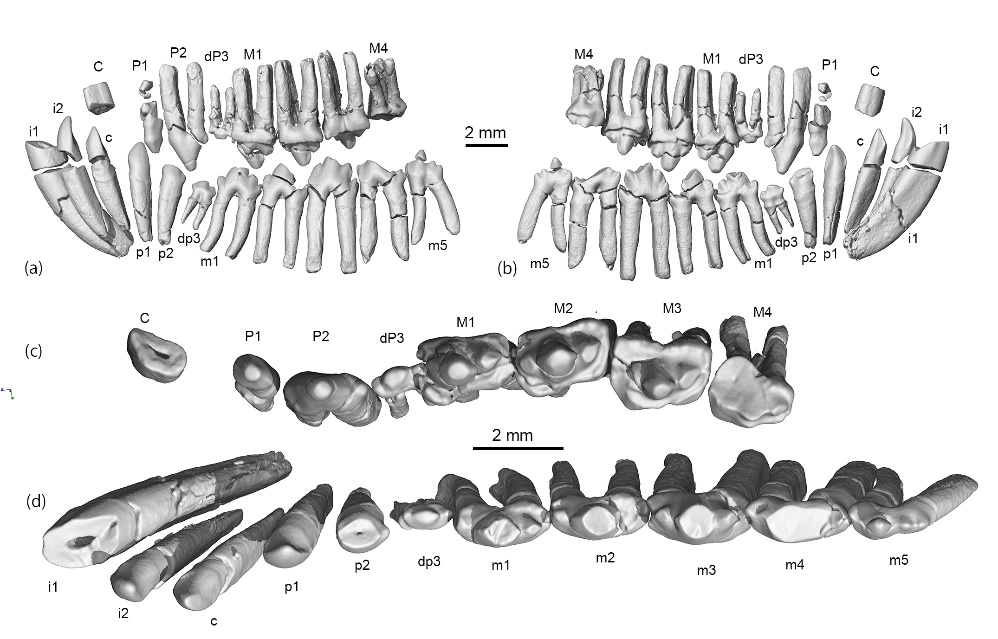
CT reconstruction image of Gobiconodon zofiae (holotype, IVPP V12585)
The new species G. gongzhulingensis discovered by the research team in the Late Cretaceous Changchunsaurus fauna in Gongzhuling, Jilin, preserves a right maxillary fragment with five cheek teeth, with a gradually increasing height of the upper tooth row, a step-like cingular arrangement in the right first molar (M1R) and fourth molar (M4), an enlarged cusp A with cusp B absent, and cusps A, B, and C arranged in a weakly triangular distribution. The molar wear facets are well preserved, allowing interpretation of its occlusal pattern.
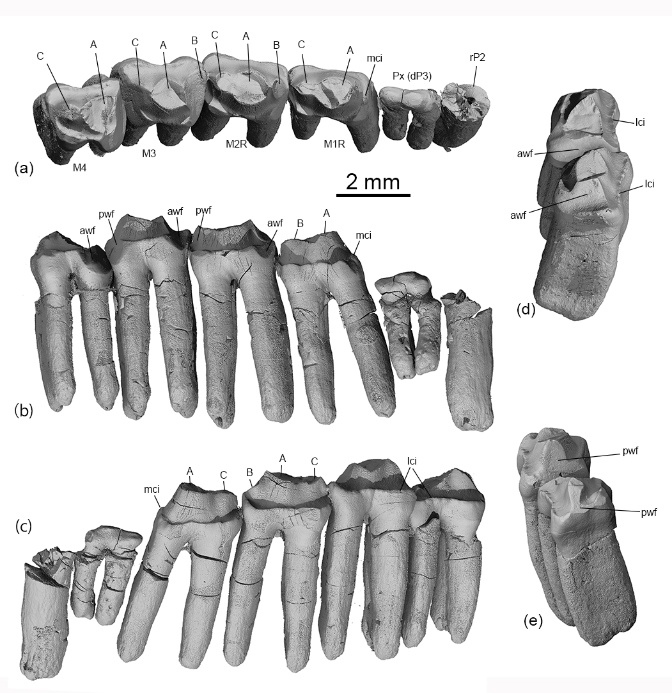
Reconstruction image of right upper teeth of Gobiconodon gongzhulingensis sp. nov. (holotype, RCPS VJ8001)
Through detailed analysis of the tooth wear morphology of Gobiconodon, the research team found that the widening of the molars in Gobiconodon is not achieved by rotation of cusps or addition of new cusps, but by broadening of the ridges, a new attempt in tooth evolution. The upper molars formed transverse wear grooves, indicating obvious labiolingual relative displacement between the lower and upper dentitions, and similar transverse grooves are also present on the upper molars of G. borissiaki and G. hoburensis. This suggests that its occlusion may include two phases (a vertical occlusal phase and a transverse shearing phase), in contrast to the unidirectional chewing pattern of triconodontids, reflecting dietary differences and also demonstrating the diverse ecomorphological specialization and species differentiation of eutriconodonts.
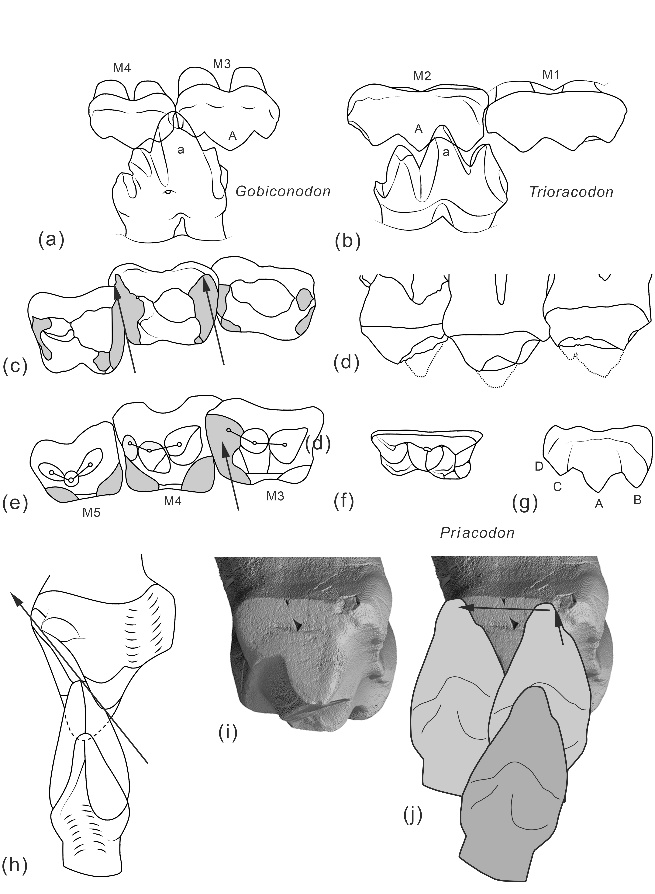
Comparison of tooth occlusion and chewing movement between triconodontids and Gobiconodon
This study not only advances our understanding of the evolutionary history of the genus Gobiconodon but also provides new evidence for revealing dietary differentiation and tooth functional adaptation in Mesozoic mammals.
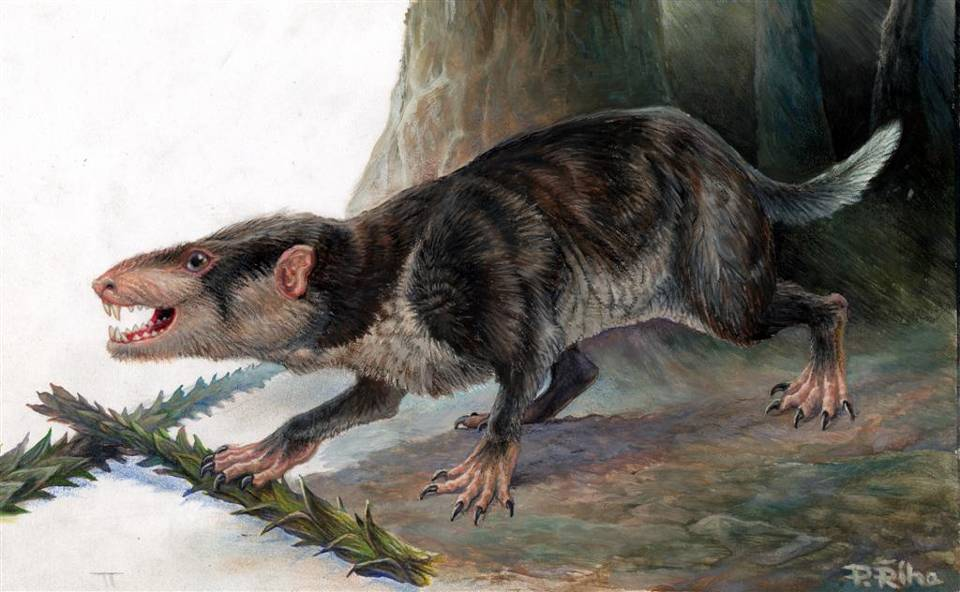
Reconstruction of Gobiconodon (illustration: Pavel Riha)
The species name "zofiae" of Gobiconodon zofiae, which is restudied in this paper, comes from the renowned late Polish paleontologist Zofia Kielan-Jaworowska; Acta Palaeontologica Polonica specifically published this article online as an Editors' Choice on April 25, 2026, to commemorate the 101st anniversary of her birth (born April 25, 1925).
This study was funded by the National Key R&D Program of China, the National Natural Science Foundation of China, the China Geological Survey Project, and the Youth Innovation Promotion Association of the Chinese Academy of Sciences.
Original link: http://doi.org/10.4202/app.01313.2025
Wu Wenhao, Mao Fangyuan*, Chen Jun, Meng Jin. A new gobiconodontid from the early Late Cretaceous Changchunsaurus Fauna in comparison with Gobiconodon zofiae (Mammalia, Eutriconodonta). Acta Palaeontologica Polonica, 2026. DOI: 10.4202/app.01313.2025
