Recently, a research team from Jilin University, in collaboration with the China Geological Survey and China University of Geosciences (Wuhan), published their latest findings in the international authoritative journal Review of Palaeobotany and Palynology. Using macro-charcoal fossils from the Middle Jurassic Xishanyao Formation in the Junggar Basin, Xinjiang, the study systematically revealed the characteristics of Middle Jurassic wildfire activity, paleoatmospheric oxygen levels, and paleoclimatic environments, providing crucial new evidence for understanding terrestrial ecosystem evolution during the Jurassic greenhouse period.
Wildfires and the Earth System
Wildfires are an integral part of the Earth system, profoundly influencing climate, vegetation, and biogeochemical cycles. The large quantities of greenhouse gases and aerosols released by wildfires not only alter atmospheric composition but also strongly absorb solar radiation through black carbon aerosols, making them a significant secondary driver of global warming. Since the Silurian period (approximately 430 million years ago), when terrestrial vascular plants colonized the land, wildfire events have recurred in terrestrial ecosystems. At least two major wildfire peaks occurred in geological history: the first during the Carboniferous-Permian, and the second during the Cretaceous.
Key Findings
The research team conducted systematic taxonomic identification and reflectance measurements on charcoal fossils from 9 charcoal-bearing layers of the Xishanyao Formation in the KD1 well of the Junggar Basin, achieving several important discoveries:
First, the study conducted the first detailed systematic taxonomic investigation of charcoal fossils from the Xishanyao Formation, identifying cf. Protophyllocladoxylon gymnosperm wood. This represents a significant breakthrough in charcoal taxonomic research for this region, where previous studies broadly categorized charcoal sources as gymnosperms or woody plants without precise generic-level identification.
Second, abundant macro-charcoal fragments (0.3-2.0 cm in diameter, mostly 0.5-1.5 cm) provide high-fidelity evidence of local wildfire activity. These charcoal fragments are angular, poorly sorted, and randomly oriented, indicating limited transport distance and proximal deposition.
Third, based on the established reflectance-temperature correlation model, the calculated minimum wildfire combustion temperatures range from 318 to 493 °C, characteristic of low-temperature, low-intensity surface fires. This result is consistent with previous studies, indicating that Middle Jurassic wildfires in the Junggar Basin were dominated by frequent low-temperature surface fires.
Fourth, the study infers that Middle Jurassic atmospheric oxygen concentrations exceeded 15%, potentially reaching 28.3%. This result is consistent with atmospheric oxygen curves reconstructed from inertinite content in coals, but contradicts predictions from geochemical models such as GEOCARBSULF (12%-14%), highlighting the tension between model predictions and empirical evidence.
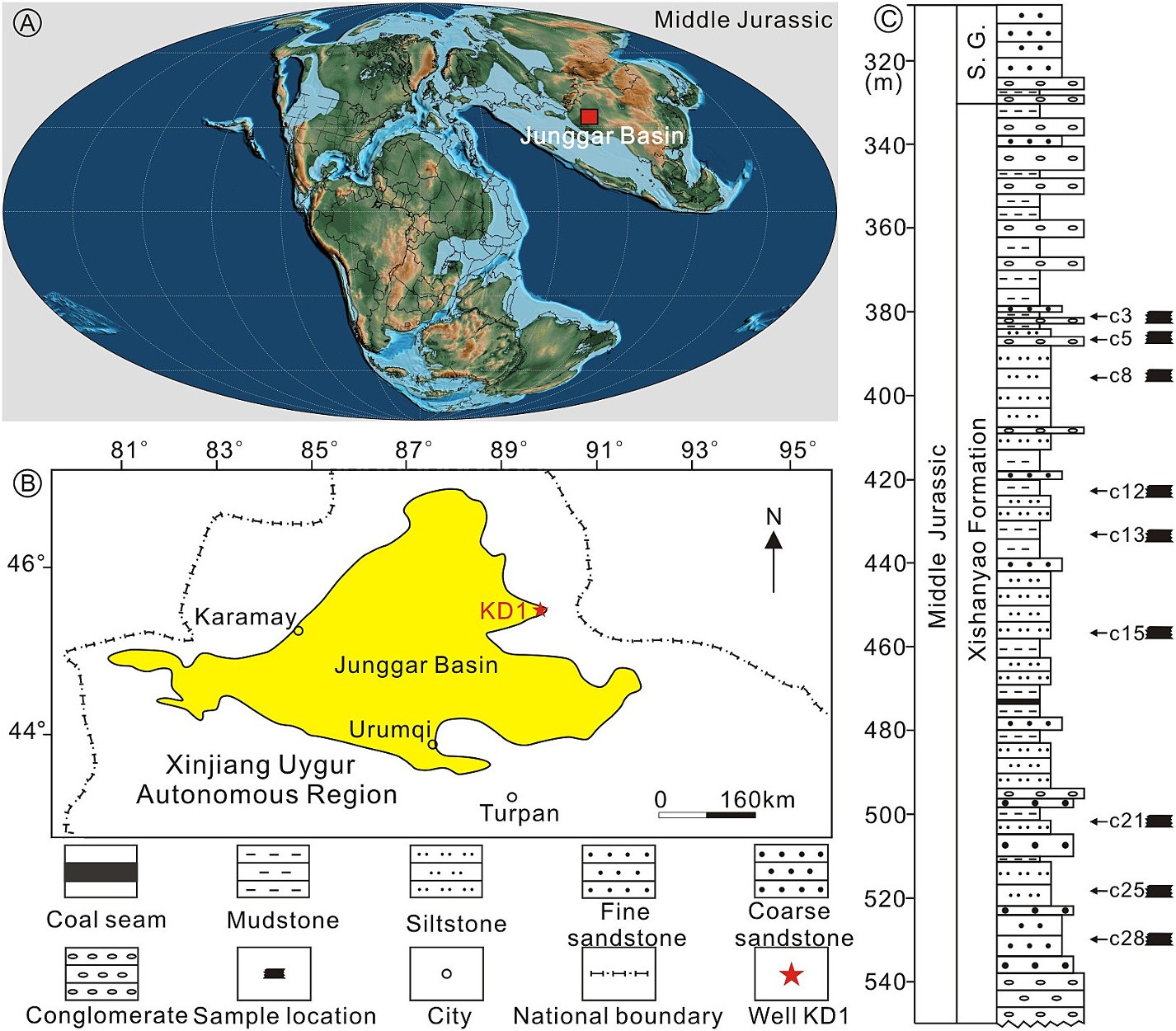
Fig. 1 (A) Paleogeographical reconstruction showing the Junggar Basin in the Middle Jurassic (red square); (B) simplified map of the Junggar Basin (red star = KD1 well location); (C) stratigraphic column of the Xishanyao Formation in the KD1 well (arrows indicate charcoal-bearing horizons)
Geological Setting and Paleoclimatic Significance
The Junggar Basin is located in northern Xinjiang, between the Tianshan and Altai orogenic belts, and is an important Jurassic terrestrial sedimentary region in the eastern segment of the Central Asian Orogenic Belt. The Xishanyao Formation consists of terrestrial clastic sediments dominated by light gray sandstone, gray-black mudstone, and coal seams, primarily developing braided-river delta and lacustrine depositional systems. Palynological assemblage studies indicate its geological age as early Middle Jurassic (Aalenian-Bajocian).
The Jurassic was a typical "greenhouse period" in geological history, with atmospheric carbon dioxide concentrations and temperatures far exceeding modern levels. Previous palynological studies have demonstrated that the early Middle Jurassic in the Junggar Basin and surrounding regions was characterized by a warm and humid subtropical climate, punctuated by intermittent dry intervals. Paleotemperature reconstructions indicate that mean annual temperatures during this period were 3-5 °C higher than modern values, with enhanced thermal convection creating ideal conditions for thunderstorm development. Lightning strikes were the most common ignition source for paleo-wildfires. Gymnosperms-particularly conifers and cycads-flourished during this period, and their lignin-rich communities provided ample fuel for paleo-wildfires.
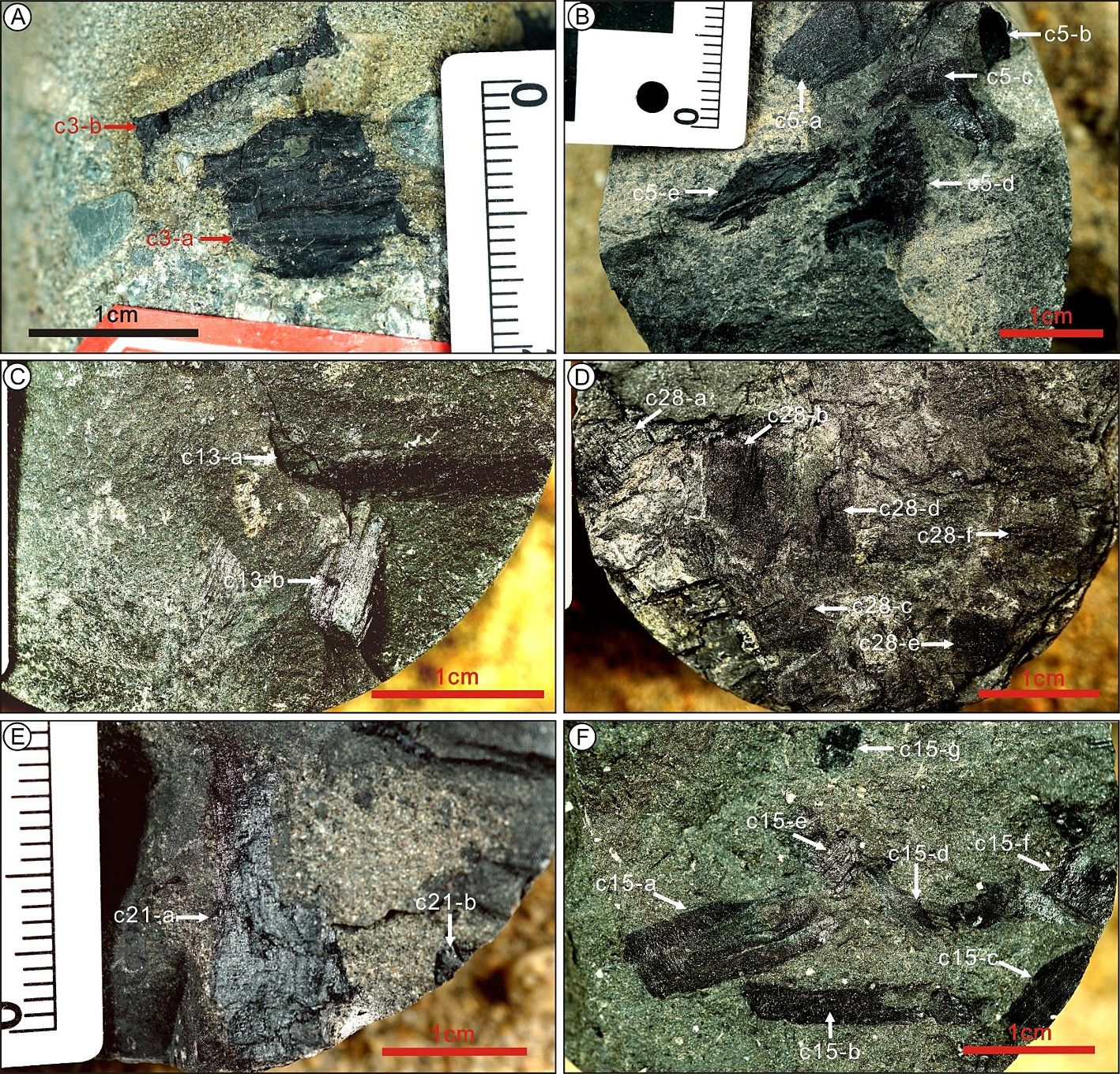
Fig. 2 Fossil charcoals from the Xishanyao Formation in the KD1 well (A: sample c3; B: sample c5; C: sample c13; D: sample c28; E: sample c21; F: sample c15)
Charcoal Anatomical Structure and Taxonomic Identification
The study conducted detailed anatomical observations of charcoal fossils using scanning electron microscopy (SEM). The cf. Protophyllocladoxylon specimens display a pycnoxylic and homoxylous secondary xylem structure: tracheids in transverse section are rectangular, square, or circular, with radial lumen diameters of 3-62 μm showing a systematic decrease, possibly indicating growth interruption related to environmental stress. Radial walls display predominantly araucarian-type bordered pits that are uniseriate and typically contiguous or occasionally separated, with aperture diameters of 3-6 μm. Rays are uniseriate and low, measuring 2-10 cells in height. Cross-field pits contain 1-2 simple, window-like or oval pits with diameters of approximately 12-48 μm. Some specimens show uniseriate small pits on tangential tracheid walls. However, due to alteration of anatomical details by charring, the precise morphology of cross-field pits cannot be reliably determined, and the researchers adopted the conservative open nomenclature cf. Protophyllocladoxylon.
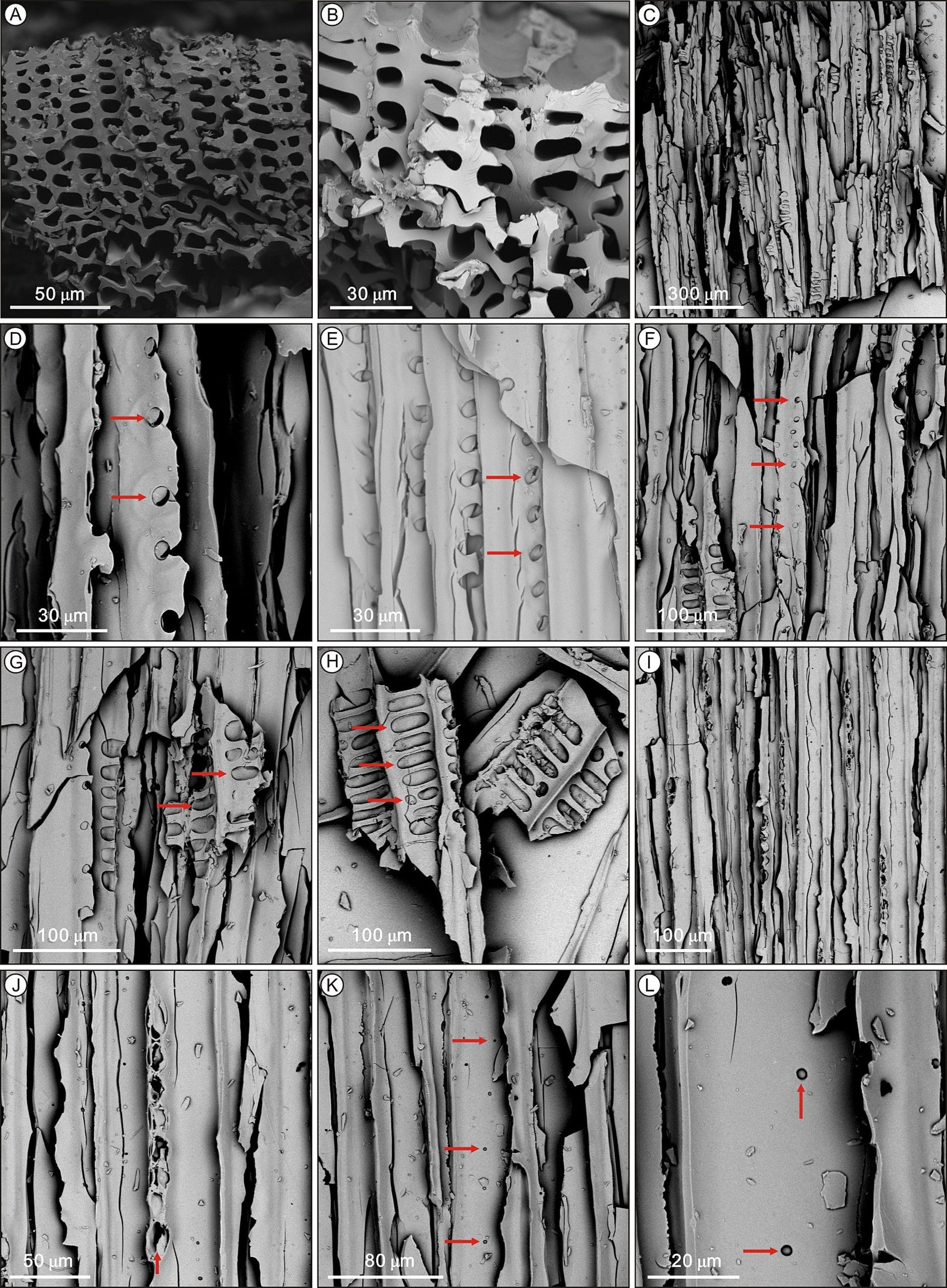
Fig. 3 Anatomical structure of cf. Protophyllocladoxylon (A. overview of transverse section; B. close-up of tracheids; C. overview of radial section; D–F. radial section showing uniseriate, continuous, or occasionally separated pits on tracheid walls (arrows); G–H. radial section showing 1—2 simple, window-like or oval cross-field pits (arrows); I. overview of tangential section; J. close-up of ray (arrow); K–L. tangential section showing pits on tracheid walls (arrows)
Constraints on Paleoatmospheric Oxygen Levels
The discussion on paleoatmospheric oxygen levels is particularly noteworthy. Experimental studies indicate that a minimum oxygen concentration of 15% is required to sustain biomass combustion. However, Falkowski et al. (2005) geochemical model shows that early Middle Jurassic atmospheric oxygen concentrations were significantly below 15%, while Berner (2006) GEOCARBSULF model indicates Jurassic oxygen concentrations of 12-14% throughout the period. These model predictions are significantly inconsistent with the wildfire empirical evidence. Meanwhile, Glasspool and Scott (2010) reconstruction based on inertinite content in coals suggests Jurassic atmospheric oxygen averaged over 25%, with Aalenian-Bajocian values reaching 28.3%; Bergman et al. (2004) COPE model yields estimates of 21-22%. The wildfire records from this study strongly support the latter—atmospheric oxygen concentrations must have exceeded 15% to sustain wildfires, and the actual values may have been substantially higher.
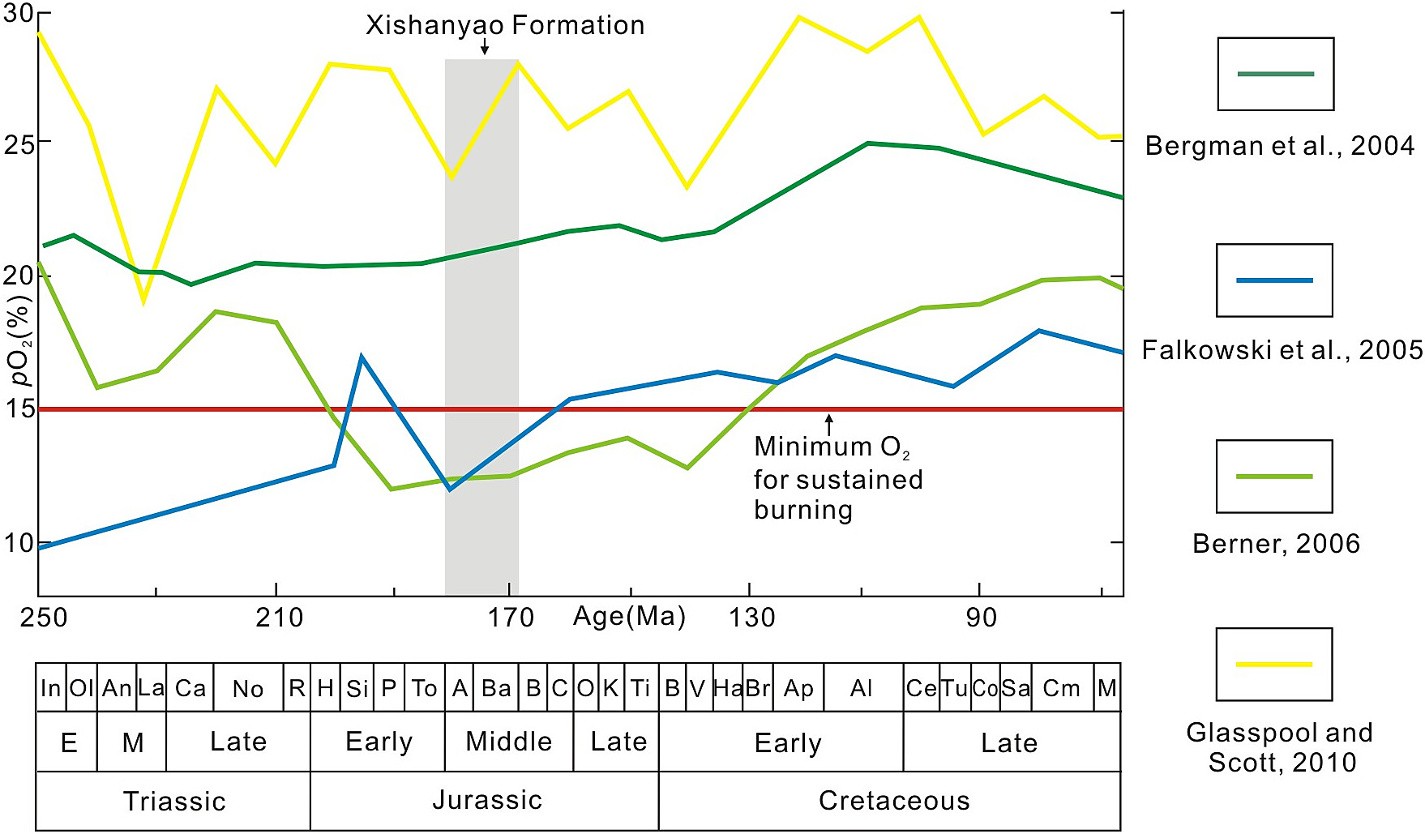
Fig. 4 Comparison of models for variations in paleoatmospheric p(O₂) for the Mesozoic Era (shaded vertical bar represents the approximate age range of the Xishanyao Formation)
Significance and Future Perspectives
This study represents the first detailed systematic taxonomic identification of charcoal fossils from the Xishanyao Formation in the Junggar Basin, filling a significant gap in precise plant source identification for charcoal in this region. The results systematically reveal Middle Jurassic wildfire types, combustion temperatures, atmospheric oxygen levels, and paleoclimatic conditions, providing important new data for Jurassic paleoclimate and wildfire activity reconstruction. Furthermore, the study highlights the discrepancy between model predictions and empirical records, challenging existing atmospheric evolution models.
Future research should integrate multiple parameters—such as the spatial configuration of depositional systems and detailed grain-size distributions-to better constrain charcoal transport-burial processes and their paleoenvironmental implications. Additionally, precise reconstruction of paleoatmospheric oxygen levels still requires support from more independent lines of evidence. These efforts are of great significance for deepening our understanding of terrestrial ecosystem evolution and regional climate regulation during the Jurassic greenhouse period in northwestern China.
Paper Information
Title: Evidence for Early Middle Jurassic wildfires: New macro-charcoal records from the Xishanyao Formation, Junggar Basin, Northern Xinjiang, China
Journal: Review of Palaeobotany and Palynology, 348 (2026) 105518
Authors: Bing Yang (Cores and Samples Center of Natural Resources, China Geological Survey), Yuling Na (Geological Museum of Jilin University*), Xiao Shi (College of Earth Sciences, Jilin University*), Yi Wei (North China Institute of Science and Technology), Xinzhi Zhang, Bing Wang, Siyuan Sun, Weitong Li
DOI: https://doi.org/10.1016/j.revpalbo.2026.105518
Funding: National Geological Cores and Samples Archive Resources and Service System Construction Project (DD2026101021), China Geological Survey Project (DD20230138), Hebei Education Department Project (KCJSZ2025105)
